1838
Edmund Becquerel observed and published findings about the nature of materials to turn light into energy. They were considered interesting, but were not pursued.
1860 - 1881
Auguste Mouchout was the first man to patent a design for a motor running on solar energy. Receiving funds from the French monarch, he designed a device that turned solar energy into mechanical steam power and soon operated the first steam engine. He later connected the steam engine to a refrigeration device, illustrating that the sun’s rays can be utilised to make ice! He was awarded a medal for this.
His groundbreaking research was cut short though. The French renegotiated a cheaper deal with England for the supply of coal and improved their transportation system for the delivery thereof. Mouchout’s work towards finding an alternative was no longer considered a priority and he no longer received any funding from the monarch.

1873
Willoughby Smith, a Brit, experimented with the use of selenium solar cells after discovering it’s sensitivity to light while testing material for underwater telegraph cables.
1876 - 1878
William Adams, wrote the first book about Solar Energy called: A Substitute for Fuel in Tropical Countries. Him and his student Richard Day, experimented with the use of mirrors and was able to power a 2.5 horsepower steam engine. Much bigger than the Mouchout's 0.5 horsepowered steam engine. His design, know as the Power Tower concept, is still in use today.
1883
Charles Fritz turned the sun's rays into electricity. His solar cell had a conversion rate of only 1-2%.Another big milestone for solar energy history!
1885 - 1889
Charles Tellier, a Frenchman who is seen as the father of refrigeration, experimented with a non-concentrating/ non-reflecting solar motor. He installed the first solar energy system for heating household water on top of his very own roof. However, his desire to pursue his refrigeration interests led to his abandonment of solar energy experiments.
1868 - 1888
John Ericsson, an American immigrant from Sweden wrote these powerful words: "A couple of thousand years dropped in the ocean of time will completely exhaust the coal fields of Europe, unless, in the meantime, the heat of the sun be employed." He dismissed Mouchout's work and also developed a solar powered steam engine, very similar in design to Mouchout's.
Solar Energy history continues into the 20th century...
1892 - 1905
Aubrey Eneas formed the first Solar Energy company - The Solar Motor Co. They sold the first Solar Energy system to Dr. A.J. Chandler of Mesa, Ariz for $2,160. It was destroyed less than a week later by a windstorm. They sold a second one to John May, but that one too, was destroyed by a hailstorm shortly afterwards. This led to the company's downfall.
1904
Henry Willsie recognised the need to store generated power and built 2 huge plants in California. He was the first to successfully use power at night after generating it during the day. Even so, he was not able to make a sale and his company too folded.

1906 - 1914
Frank Shuman's company, Sun Power Co, built the largest and most cost-effective solar energy system covering 10,000 square feet plus. Although it produced a lot of steam it did not produce enough pressure. Together with E.P. Haines he then formed Sun Power Co. Ltd. They built an irrigation plant just outside of Cairo, but unfortunately it was destroyed during the Great War.
1954
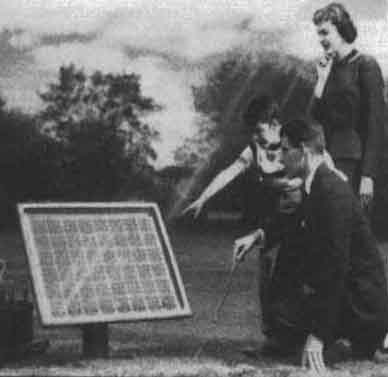
Calvin Fuller, Gerald Pearson and Daryl Chaplin of Bell Laboratories accidentally discovered the use of silicon as a semi-conductor, which led to the construction of a solar panel with an efficiency rate of 6%.
1956
The first commercial solar cell was made available to the public at a very expensive $300 per watt. It was now being used in radios and toys.
1950s - 1960s
Space programs employed solar technologies. In 1958 the Vanguard I was launched. The first satellite that used solar energy to generate electricity.
1970
The Energy Crisis ! (OPEC oil embargo). A bit of solar energy history we are all familiar with. Suddenly it became important to find an alternative form of energy as we realised just how reliant we really are on non-renewable, finite resources like coal, oil and gas for our existence.
Solar energy history was made as the price of solar cells dropped dramatically to about $20 per watt.
1980 - 1991
A Los Angeles based company called Luz Co. produced 95% of the world's solar-based electricity. They were forced to shut their doors after investors withdrew from the project as the price of non-renewable fossil fuels declined and the future of state and federal incentives were not likely.
The chairman of the board said it best: "The failure of the world's largest solar electric company was not due to technological or business judgment failures but rather to failures of government regulatory bodies to recognize the economic and environmental benefits of solar thermal generating plants."
Solar energy history played a big part in the way society evolved and will continue to do so --
Today
There is a renewed focus as more and more people see the advantages of solar energy and as it becomes more and more affordable.
Governments across the world offer financial assistance.
Solar electric systems are now used to power many homes, businesses, holiday cottages, even villages in Africa.
We see solar cells powering anything from household appliances to cars.


 Posts
Posts