Wind Power

Wind power is the conversion of wind energy into a useful form of energy, such as using wind turbines to make electricity, windmills for mechanical power, windpumps for water pumping or drainage, or sails to propel ships.

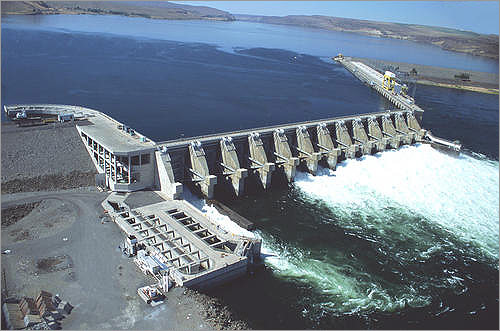
Hydropower

Hydro-power system (hydroelectric power) is a clean source of energy systems that can neither pollute or be consumed during its operation. Learn more here.

Solar Energy

There is a renewed focus as more and more people see the advantages of solar energy and as it becomes more and more affordable. Learn more about solar energy here!

10 WAYS TO KEEP COOL AT HOME WITHOUT AIR-COND

Save energy during hot day. It’s easy to keep your house cool without air conditioning. Employing a few basic environmentally friendly principals will help keep you cool and will help you save money.

10 TIPS TO SAVE ENERGY, MONEY IN YOUR HOME

A whopping 46 percent of home energy use is, umm, energy loss! In other words, no productive energy use at all! Here are simple ways of reversing this, mostly by changes of habit.

Showing posts with label News. Show all posts

The need to switch to renewable energy

Climate scientists have long warned us that global warming is accelerating due to the continuous rise of greenhouse gas emissions such as carbon dioxide into the earth’s atmosphere.

Unless quick action is taken to reduce or stop such emissions, global temperatures will continue to rise, resulting in irreversible damage to our natural habitat.

Josef-Fell ... ‘There’s a need to switch fast to renewable energy to mitigate the impact of rising fossil-fuel cost.’

Many governments are convinced of the urgency to develop strategies that could help alleviate global warming by incorporating climate protection strategies into their economic models.

Hans-Josef Fell, a German parliamentarian and spokesman for the country’s green energy policy, believes that the world economy needs to switch from a fossil-fuels based energy to renewable energy in order to achieve sustainability.

Fell was recently in Malaysia to give a speech at the inaugural Energy Expert Series organised by Malakoff Corp Bhd as part of the company’s community partnership programme.

“The price of fossil fuels (including coal, oil and natural gas) will continue to rise over the years, and these resources are fast depleting due to rising demand for them, and what’s more, these resources are not replenishable,” Fell explains.

“So, there’s a need to switch fast to renewable energy to mitigate the impact of rising fossil-fuel cost on the economy, as well as avert the negative implications of depleting mineral resources, on top of (reducing) carbon emission,” he adds.

The main appeal of renewable energy, which can be derived from naturally replenishable resources such as solar, wind, hydro, wave and geothermal heat, is that it does not cause pollution.

In Malaysia, this theme of sustainability has become increasingly important.

Take, for instance, the incorporation of green technology into the Energy, Green Technology and Water Ministry as well as the launch of the National Green Technology policy last year.

As it currently stands, however, electricity generation in Malaysia is still largely dependent on fossil fuels - coal, oil and natural gas account for around 85% of total electricity generation in the country, while renewable resources make up only around 1%.

According to Ahmad Hadri Haris – the renewable energy advisor to the Energy, Green Technology and Water Ministry, the target is to increase the usage of renewable energy to at least 9% of total electricity generation in Malaysia by 2020.

Hadri is also the chief technical advisor of the Malaysian Building Integrated Photovoltaic (MBIPV) project.

Towards this end, the Malaysian Renewable Energy Act, or RE Act, is currently being drafted by the ministry.

The bill is expected to be tabled in Parliament in October.

“The RE Act is the foundation of promoting renewable energy in the country,” Hadri explains.

But Fell emphasises that an RE Act should be more than just a policy.

“A detailed action plan is also needed,” he says.

The RE Act will incorporate all the critical factors that will ensure the success of the renewable energy sector in the country, according to Ahmad Hadri. These include guaranteed access to the power grid for private producers of renewable energy and high feed-in tariff rates to produce attractive returns on investment and a fixed tenure for those rates in order to provide certainty to investors.

The feed-in tariff rates and duration proposed to the Government vary according to the type of renewal resources.

For instance, wind would command a rate of 23 to 35 sen per kilowatt for 21 years, biomass 24 to 35 sen per kilowatt for 16 years and solar at RM1.25 to RM1.75 for 21 years.

The objective is to ensure a rate of return on investment in renewable energy of between 5% and 13%. It is understood that if the RE Act were to be passed by Parliament within this year, feed-in tariffs for renewable energy would be implemented by 2011.

Feed-in tariffs is a concept aimed at reducing long term cost barriers for the public to work alongside the Government to achieve energy security, mitigate climate change and energy autonomy, while spurring new economic activities.

“Renewable energy deserves much more focus, and there must be serious commitment by all parties, including consumers and individuals, to make our energy green,” says Malakoff chairman Tan Sri Abdul Halim Ali.

He adds that green policies are no longer just “feel good” concepts, but are real issues that we must embrace. “Promoting green energy is not only socially responsible, but it is also commercially and economically viable,” Abdul Halim reckons.

Based on projections by experts, Ahmad Hadri says the renewable energy sector could provide at least RM70bil worth of business revenue for the private sector, and could potentially generate tax revenue of at least RM1.76bil for the Government by 2020.

Another economic and social benefit arising from the renewable energy sector is job creation. Experts have estimated that at least 52,000 jobs could be created from the construction, operation and maintenance of renewable energy plants by 2020.


By The Star Online.

Renewable energy needs a push

FAST-DEPLETING fossil fuels and rising greenhouse emissions have led to a race among nations to drive the agenda of renewable energy (RE).

In Malaysia, while the pursuit of renewable resources may pale in comparison to other major countries, there have been a few strides towards this end.

Just over the week, the country's largest renewable energy park by Cypark Resources Bhd was launched while a milestone is expected to be marked with the Renewable Energy Act expected to be passed soon. Public participation has also increased, especially following the near-nuclear disaster in Japan which has prompted the masses to urge the Government to relook its plans to introduce nuclear energy in Malaysia.

Energy, Green Technology and Water Ministry's RE/Malaysia Building Integrated Photovoltaic Technology Application (MBIPV) national project team leader and chief technical adviser Ahmad Hadri Haris says the RE prospects are bright as Malaysia has resources it can readily tap, such as solar, biogass, biomass and hydro.

“However, renewable energy needs intervention to grow. It will get a push from the Renewable Energy Act. With the Act, interested parties can develop renewable energy in a safe and secured manner as the generation can be sold to Tenaga Nasional Bhd (TNB) over a guaranteed period,” says Ahmad Hadri.

Essentially, the RE Act will enable individuals/investors to earn income by selling electricity generated from renewable resources at home to utility companies.

“We expect the second and third reading this month ... the Act will be enforced probably in May or June, so the feed-in-tariff (FiT) will also come on board then,” says an industry player.


Promoting renewables

Concurrently, the Sustainable Energy Development Authority (Seda) Bill, which is to institute the establishment of Seda Malaysia will also be tabled. Seda will be responsible to spearhead renewable energy development as well as to manage the FiT programme. A fund will also be established and administered by Seda. A 1% tariff hike could come about to cover cost associated with the FiT scheme when it comes into force.

Ahmad says it would be a very minimal impact given that 1% of a RM100 electricity bill would cost RM1. He says some 56% of the nation would not be impacted as they consume less than 200kwh a month.

Under the FiT, up to 30MW of electricity generated from four renewable sources, solar photovoltaic, biogas, biomass, and small hydro, are eligible to apply to connect its power generator to the national grid, and sell the power back to utility companies such as TNB, Syarikat Sesco Bhd and Sabah Electricity Sdn Bhd.

What it means is that if you have a solar photovoltaic (PV) generator at home, you can apply to connect this generator to the grid, and get paid for selling the electricity to TNB over an agreed timeframe.


Ambitious targets

Malaysia plans to achieve 985MW or 5.5% share of renewable energy in the energy mix by 2015. Currently, renewable energy contributes less than 1% to the energy mix in Malaysia. By 2020, the target is for renewable energy to comprise 11% or 2,080MW of overall electricity generation in the country.

Currently, the country's energy demand is largely met by fossil fuels. OSK Research head Chris Eng says the passing of Renewable Energy Act would be “crucial” to achieve the Government's target: “I think key to driving the adoption of renewable energy at the end of the day would be the act.”

He says the target of 985MW by 2015 and 2GW energy to be sourced from renewable energy remains tough as currently the electricity generated from green energy is limited.

According to the Energy Commission chairman Tan Sri Ahmad Tajuddin Ali, renewable energy will be moved out from its portfolio to be managed under Seda once the Act is passed.

He says currently the country is producing some 500MW electricity from renewable energy but only 50MW is connected to the grid as other are used in-house such as the plantations sector.

Tajuddin says the FiT has to be ready in order to lower the hurdle in investing in renewable energy project or many project will not kick off as it is not viable economically.

MBIPV's Ahmad believes the target of achieving 11% of overall electricity generated by renewable energy by 2020 is achievable.

“Yes, because the target is very modest in comparison to what has been achieved in other countries (closest to us is Thailand).

International FiT expert and independent energy policy consultant and researcher at the Environmental Policy Research Centre of Freie Universitat, Berlin, David Jacobs believes the short-term target of 5.5% is definitely achieveable. He says, however, Malaysia should have a more ambitious long-term target.

“With Malaysia targeting to achieve 25% of total usage of renewable energy by 2050, other countries would be in the 60%-70% range by then.”


Hurdles aplenty

Among the challenges faced in this drive towards renewable energy is the lack of understanding as well as the current distortion that exists in power generation cost given the subsidy elements. In addition, others contend that while Malaysia may appear to be a solar-rich country, effective sunlight is low, curtailed by the fact that its skies are cloudy. As for wind turbines, others contend that the wind speed in the country is not strong enough.

Cypark director K.K. Siow does not agree with critics who say that cloud covers make it less attractive to invest in solar energy. He says the radiance is strong enough, explaining that 10MW produced in Pajam could supply power to some 40,000 to 50,000 people in the area.

Ahmad is confident these challenges can be overcome: “There are solutions for any problem. We just need to adopt the correct one for Malaysia ... a technology in Europe may not be suitable in Malaysia.

“For example, the thin-film solar technology is less accepted in Europe, but is proven to be better in Malaysia's cloudy climate. In Malaysia, we can generate 1.3 times more solar power output than Germany (the current No. 1 country in the solar market),” he says, adding that the same applies to wind. “Thus we just need to find the right technology for Malaysian climate.”


Whither electricity prices?

On the impact of the RE Act to end users, most observers contend it would likely be minimal and not as significant as say, if gas subsidy were to be removed or if coal prices continue to climb.

“The impact from Act is only 1% at the next tariff review. In any case, for this year, the Government has already allocated a fund to start the Act. In the mid to long term, as the country uses more than 50% of renewable energy in the mix, Malaysia can better control its energy imports and would be less affected to price volatility. Thus, we can become more energy independent,” Ahmad Hadri says.

One of the notable developments in the industry is the opening of a 26ha renewable energy park in Pajam, Nilai by the Prime Minister Datuk Seri Mohd Najib Razak. Cypark invested RM94.29mil to build the park with national grid connection on a remediated landfill.

Comprising a 2MW biogas plant and a 8MW solar power facility, the RE Park is expected to generate RM12.16mil in gross national income in 2020.

The RE Park involves the integration of three potential resources available at the landfills such as solar, landfill gas and waste into a scalable renewable energy project generating up to 10MW of power in the Pajam landfill.

Cypark group chief executive officer Daud Ahmad says Pajam landfill is one of the 17 landfills that the Government has mandated to close down. Cypark will replicate ways of unlocking the economic value of the land for the remaining 16 landfill sites and it has also proposed to do the same for another 32 landfills.

“With the additional 32 landfills and the existing 17 landfills, producing 100MW is not an issue,” he says.

In Cypark case, it uses land (landfills) of no economic value which could not be use for any activity for the next 20 to 30 years. It is basically transforming a tract of land of negative value. “It is a 100% beneficial from an economic point of view to convert negative-value land to a fully-utilised land to produce electricity,” Daud says.

OSK's Eng says the current projects are “not particularly lucrative” given the 21 sen per kWh tarriff for all renewable energy projects but this could change.

“While the final tariff rates may still change, based on information published on May 5, 2010, the FiT for solar power generators ranges from RM1.25 to RM1.75 per kWh while that for biogas is from 28 sen-35 sen per kWh.

“This would make it much more lucrative to run a solar power and biomass or biogas power plant. Indeed, TNB has announced its own RE plants including a joint venture with Felda Global for a RM120mil fresh fruits bunches biomass plant and feasibility studies for its RM60mil solar power plant,” Eng says.


By The Star Online.

Renewable energy a growth sector for Malaysia

THE renewable energy sector is fast gaining ground as a new growth area for many countries worldwide with the vast potential it presents environmentally and economically.

Renewable energy plays a major role in meeting a country’s energy needs, enabling businesses to reap energy cost savings and revenue while combating global warming.

On the homefront, renewable energy is seen as a growth sector that will help propel the country into a high-income economy.

The sector, however, is still relatively undeveloped in the country as reflected in the low achievement of renewable energy targets under the Ninth Malaysia Plan (9MP).

According to PricewaterhouseCoopers Advisory Services associate director (sustainability and climate change) Mark Wong, the 9MP targeted the production of 350MW of grid-connected electricity from renewable sources, translating into 1.8% of electricity mix.

“However, only 53MW was achieved by the end of 2009, or 15% of the targeted capacity,” he said.

The 10th Malaysia Plan (10MP) re-emphasised the use of renewable energy to meet Malaysia’s growing energy demands, in particular hydro power for electricity generation and blending of biofuels for transport sector.

Two of the steps taken by the Government to help boost development in renewable energy sector is the plan to implement a feed-in tariff programme later this year and the mandatory blending of biofuels for transport sector in 2011.


Wong said renewable energy was expected to contribute about 6% of the country’s electricity production mix in the next five years and about 11% by 2020.

“Renewable energy is often perceived to be a green initiative that is something nice to do. What needs to be understood is that there is a strong business case for renewable energy sector in the long term,” he said.

Renewable energy advisor to the Energy, Green Technology and Water Ministry, Ahmad Hadri Haris, had said in a report that based on projections by experts, the sector could provide at least RM70bil worth of revenue for the private sector and potentially generate tax revenue of at least RM1.76bil for the Government by 2020.

Another economic and social benefit arising from the sector is job creation. Experts have estimated that at least 52,000 jobs could be created from the construction, operation and maintenance of renewable energy plants in the country by 2020.

ACCA Global head of sustainability and corporate social responsibility Henning Drager said there was a strong recognition that the dependence on fossil fuels needed to be curtailed. This is based on the Government’s support of renewables as reflected in the National Renewable Energy Policy and Action Plan.

“Communities, industries, businesses and households need a reliable energy supply to prosper.

“Ramping up the renewable energy generation percentage is crucial if Malaysia is serious about reducing fossil fuels’ contribution to climate change, addressing energy security issues around importing oil and coal from unstable global regions, and the creation of skilled and unskilled jobs in the domestic renewables sector.”

Latest projections by the Organisation for Economic Cooperation and Development is that renewable energy, especially solar power, could play a large role in Malaysia’s future energy generation. This is because the country is blessed with over 250 days of sunshine a year, thus providing great potential to meet the energy needs of businesses and communities.

Amsterdam-based international expert on corporate responsibility and sustainable development, Paul Hohnen, concurred.

He said the country’s challenges in the long term included the transition from its reliance on finite supplies of oil and gas to renewable sources such as solar power and also to ensure maximum diversity and sustainability of its ecosystems.

“At the end of the day, the sun is Malaysia’s greatest renewable asset. It sustainably powers forests and farms, as well as tourism. But there is still much untapped potential and this is where much of the growth potential is.

“If Malaysia can achieve this transition, it will create firm foundations not only for domestic solar power industries but also industries based on plant genetic diversity (such as medicines), and sustainable crops for fuel, food, fibre and fertilisation,” he said.

Drager said significant upfront investment would be required to increase the contribution of renewables based on a thorough assessment of their respective generation potential.

“Addressing any structural, political and cultural barriers to redirecting government subsidies towards this sector will be a key element for future success,” he added.

Drager said a detailed renewables job creation programme would need to be worked out by the Government to match the skills based on the renewables ambition.

“The programme should also address Malaysia’s high-income model because the highly-skilled labour required, including engineers, electricians and project managers, will be able to demand salary premiums and create aspirations around joining Malaysia’s renewables drive.”

Concrete measures and frameworks needed to be worked out across stakeholder groups and these include low and no interest loans, longer return-on-investment timelines, tax incentives and ambitious renewables targets, he said.


By The Star Online.

Related Posts Plugin for WordPress, Blogger...

Share

Twitter Delicious Facebook Digg Stumbleupon Favorites